
The Camino de Santiago is one of the most popular pilgrimage routes in the world. What started as a strictly religious pilgrimage to Santiago’s (or St James’s) shrine is now a well-loved hiking plan for religious and non-religious people and a respite from everyday routine. Although the Camino is any route you take from your home to the Cathedral of Santiago de Compostela in Spain, there are currently nine well-known routes and from those, the Camino Frances (around 800km) is the most popular and followed by the Camino Portugués, Camino Primitivo and del Norte. I did the Camino Portugués (Coastal route) in September 2024 with my boyfriend, Calvin, and it proved to be one of the most challenging, insightful and transformative experiences of our lives.
Although I love hiking and I consider myself a fairly fit person, I had never done something like this, either in time or distance. The whole thing is just like escaping into a completely different lifestyle — from working in a book warehouse Monday to Friday in Galway, suddenly I was in a new territory, a country I’d never been to before, spending every night in a different town and having only my feet as my means of transport, my belongings only what I carried in my backpack. Every day is its own, with its own rhythm and surprises. I experienced many things in those eleven days and I am grateful for the company during that experience.
We chose to do the Camino Portugués for my Calvin’s birthday and it was an unforgettable experience. As we made our way to Santiago our relationship and understanding of each other became deeper, we became more attuned to each other and our bodies, and we got to know each other in a myriad of circumstances, pleasurable and painful, that we couldn’t have experienced in our day to day lives: exhaustion, frustration and even despair, but also fulfilment, joy, and vulnerability. Freedom. A two-week adventure like this forced us to know ourselves better and as we stripped our backpacks of whatever wouldn’t be strictly useful along the way, we also stripped ourselves from superfluousness.
We had two weeks in total to do the Camino, but because we wanted to spend some time in Porto at the beginning, we decided to shorten the actual time walking, which meant walking an extra 5 to 10km some days. Now, that seemed perfectly doable for us beforehand —we’re both young and very active—, but in hindsight, I’d say there’s a reason why most itineraries don’t suggest you walk over 25km a day. After a couple of days, exhaustion added up and I had knee pain, ankle pain and shin pain like I’d never experienced before (my hiking boots were heavy, I’d recommend wearing hiking shoes). This is roughly the itinerary we followed and, although we learned a lot and will change many things for our next Caminos, it was a wonderful experience in which we met lovely, hospitable people, had great food, breathtaking views of beaches, cities and vineyards, and many adventures.
Note: For this trip we made our own schedule based on many resources we found online, but we adapted it to the time we had. We booked albergues and hostels one night in advance, which was totally fine except for Santiago. Many things in our Camino were decided spontaneously, but I think the guide that helped us the most was this one from Stingy Nomads. We mostly used the Buen Camino app and found many albergues there. We only used Google maps to calculate times, but the routes offered on Google Maps and the Buen Camino app are completely different. In hindsight, Google only made us stressed with the estimated times. The only thing you need to do is follow the yellow arrows and you'll be grand, and that's what we'll do next time. We never found the paths to be unsafe.
Day 1: Porto to Mindelo

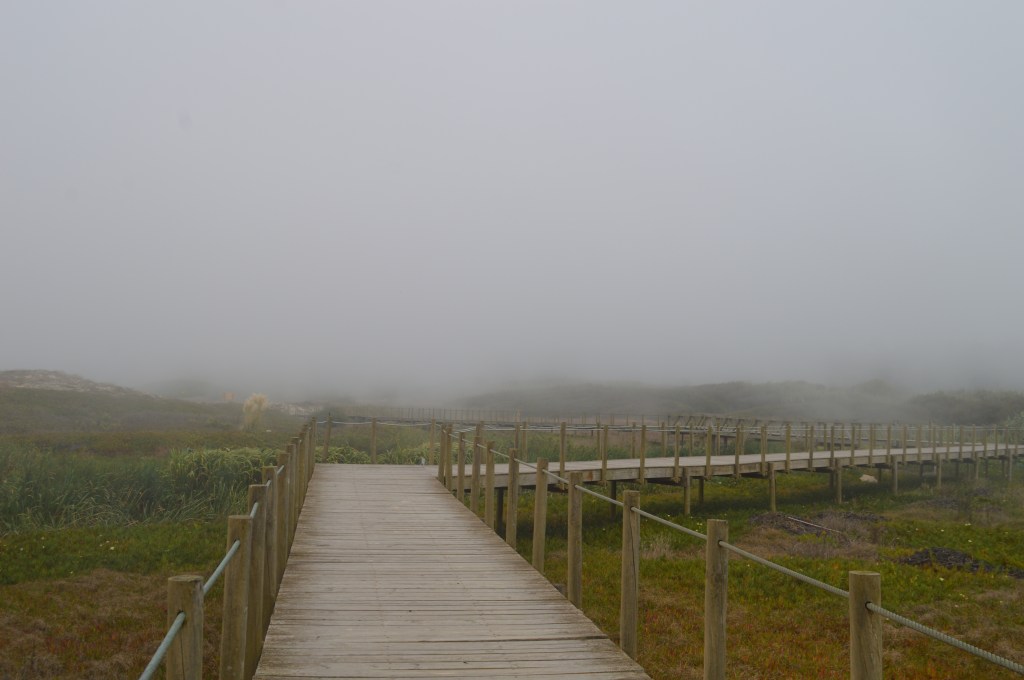
We began our journey at Porto Cathedral after a couple of days of enjoying the sun and the city, sightseeing and pasteles de nata. At first, the path follows the river Douro north to the coast, and after a couple of hours, the industrial cityscapes give way to wooden paths and sand. On the last days of September, the weather was warm and foggy. We got the first stamp on our Pilgrim Pass shortly after leaving Porto (you need at least two stamps per day to get the certificate at the end) and from then on we mostly got them at restaurants and albergues. We stayed in a room we rented in Mindelo. We left Porto at noon and arrived at 6:00 pm, so we walked roughly 6 hours at a very leisurely pace making some short stops for pictures and a relatively long stop for lunch (around 45 minutes).
Day 2: Mindelo to Povoa de Varzim – A ver o Mar (before Agucadoura)
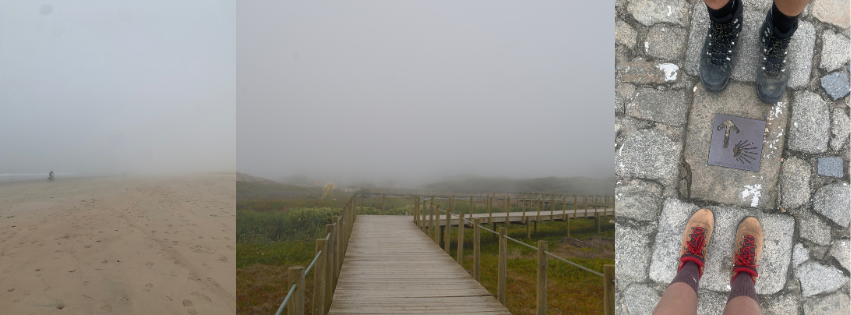
Day 2 was Calvin’s birthday, and we started it right at a bakery in Mindelo, Padaria e pastelaria Barca, where we had some of the best pasteis de nata of the trip. At noon we set off to A ver o Mar, a small village some miles after Vila do Conde (a more popular stop) again mostly along the coast on wooden bridges. We arrived at around 6:00 pm. Right after leaving, we walked through a very thick fog in Praia do Mindelo which slowed us down because visibility was very reduced and we couldn’t really make out the path, but it was beautiful. In A ver o Mar we booked a cosy little room in a lovely hostel called Guest House da Mata and had a fancy birthday dinner at a restaurant on the beach called Restaurant Gosi.
Day 3: A ver o Mar to Castelo do Neiva

On the third day, we set off a bit earlier (11:00 am), again after a breakfast consisting on mostly bread and pasteis de nata. The way to the village of Apúlia was very similar to what we had walked before, but on arrival there, the landscape changed abruptly as we moved inland. From then on, we had forests and little streams and passed some small villages. We also had the first rainy day and were thankful we’d packed those large ponchos that cover the backpacks too. We arrived after dark in Castelo do Neiva and made our way to the Albergue. We’d found the phone for the albergue on the Buen Camino app and were told it was full but we were offered a room in a house nearby. On arrival, we were picked up by a lovely man named Adriano who was super kind and had built a little bungalow in his backyard with 3 rooms to rent. He drove us to the only open restaurant too and back to the bungalow.
Day 4: Castelo do Neiva to Afife
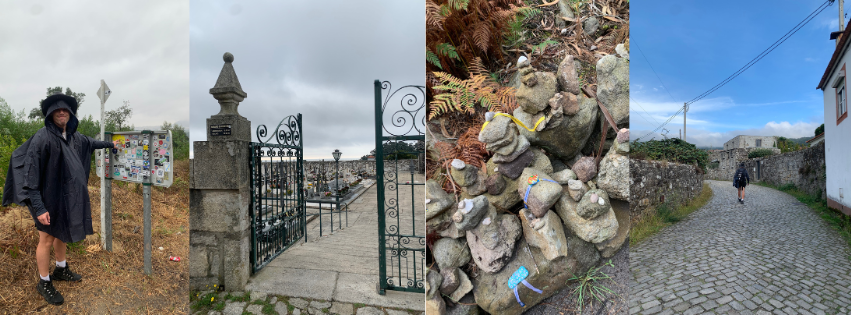
On day four I started having shin pain. We also started the walk earlier, at 9:00 am, in the rain and through forests and towns. Afife is a nice little village and we had a good rest and made enquiries to cross to Spain. One of the singularities of the Coastal Route is that you have to cross from Caminha, Portugal, to A Guarda, Spain by boat, so we tried and failed to book a service called Xacobeo Transfer– they weren’t making reservations because the weather was supposed to be bad. Still, we hoped for the best and continued the next day.
Day 5: Afife to A Guarda
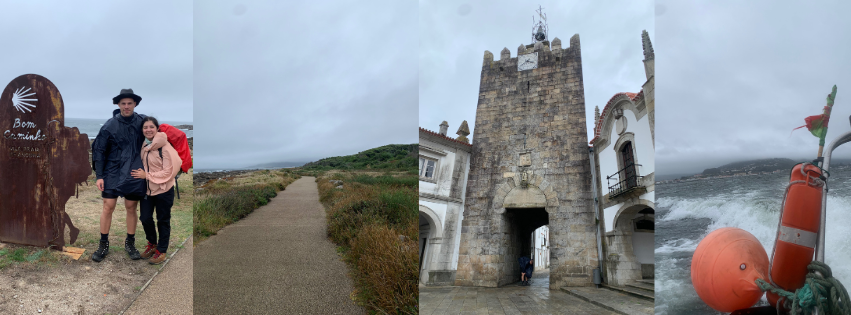
This day we walked the last bit of Portugal and the views were astonishing. After Afife the path goes back to the coast and continues along a promenade to the Medieval walled town of Caminha, which is beautiful. In Camimha we made our way to where all the boats were and found it very easy to book a ticket to A Guarda despite the strong wind. Along with four other hikers we were assigned a “taxi-mar” boat driven by my tocayo Fernando on a very wild and wet ride. By this time the weather got a bit chilly and we were soaked because the water was rough. But we all made it safely to A Guarda, where we still had a few kilometres to walk, mostly uphill, before getting to the city centre, where our hotel was. The Camino feels very different in Spain than it does in Portugal, even in A Guarda: the signs —which are yellow arrows for all the caminos— are all uniform blocks of stone with a yellow shell on a mosaic, whereas in Portugal they were just painted on corners or trees. There are also many more signs, less wilderness and more cityscapes. Our first evening in Spain was a kind of reset for us as we got to do laundry, cook and relax for a bit longer than previous days.
Day 6: A Guarda to Baiona

Our first day in Spain was sunny and the landscapes along the coast were gorgeous. We set out at around 10:00 am because I needed to buy some hiking poles (my knees had given up at this point) and we had a nice lunch at a town called Oia. The path between Oia and Baiona was lovely but we had to the last bit in the dark, which wasn’t great considering the terrain is rocky and goes uphill, but it was an adventure. Baiona is quite a big town and we saw some bits of it the next morning, but it would have been nice to have extra time to explore.
Day 7: Baiona to Vigo

Another sunny day in Spain! The path to our next stop, Vigo, was hilly and winding, mostly along rural areas. We arrived in Vigo before dusk and as it was a Friday the town was busy. We rented a room in a hostel called Hostal Real, which was cheap, cosy and central, and had dinner at a small local restaurant called La Parra de Milos. At this time we could barely walk, somehow your feet end up hurting A LOT after the hiking is done, when you’re resting, so walking from the hostel to the restaurant and back was an ordeal. Blisters, blisters, blisters.
Day 8: Vigo to Redondela

The closer you get to Santiago, the more urban the landscape becomes. The way between Vigo and Redondela was again mostly streets and alleys in semi-rural areas. The sun was out too and the terrain was hard but we got some nice views as we were walking on high ground most of the time.
Day 9: Redondela to somewhere close to A Cancela
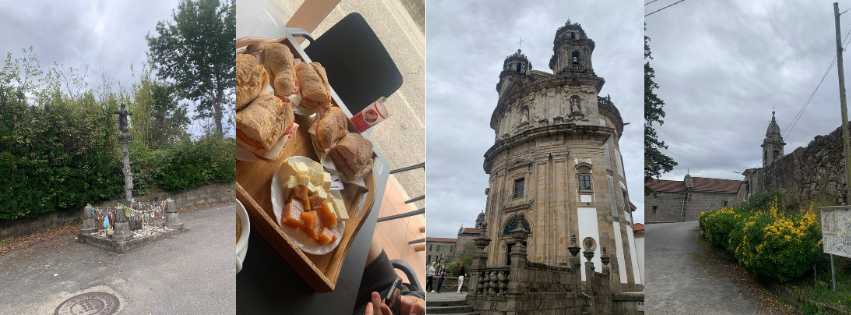
To make it in time we chose an albergue between the towns of Pontevedra and Caldas de Reis as our stop for day 9. The path from Redondela to Pontevedra was mostly rural and there were several food stops before entering the city, we also walked along vineyards, which was nice. Pontevedra itself might be one of the prettiest cities we saw in the trip but we had to make it further to keep on schedule. The next part was a bit of an adventure as we got lost and couldn’t find an ATM to pay for our room. Fortunately enough we found the albergue which was more like a guest house and the owners were kind enough to drive us to the nearest ATM and back. They also offered us lentejas con chorizo, which was probably the best meal we had in Spain.
Day 10: Pontevedra to Padrón

The second to last day was very pleasant, mostly through vineyards and forests that gave way to the urban area in Padrón, which we didn’t like that much. We stayed in a very nice and lively albergue though, just on the outskirts of the city, and we could feel the excitement of other hikers as Padrón is for most people the last stop before Santiago.
Day 11: Padrón to Santiago de Compostela
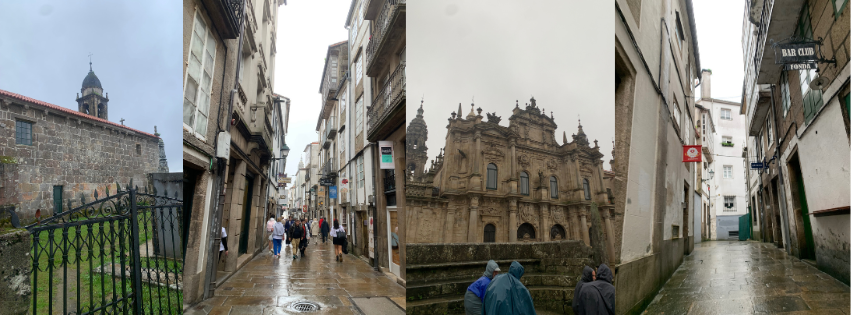
The last day felt very long. We started off at approximately 9:30 and got to Santiago shortly after 4:00 pm. Although we were excited to have made it, this part of the walk was my least favourite, perhaps because of the urban landscapes and the fact that Santiago, though big, is not a very pretty city apart from the old town. It is also hell to find accommodation there as most albergues are very far from the Cathedral and we had to book a hotel. It also started pouring when we arrived in the city centre. Once you get there you have to get your Pilgrim Pass verified at the Tourism Office where you’ll get your certificate. After we did that we queued for the Cathedral but couldn’t get in with the backpacks, so we decided to go back the next morning.
I couldn’t help but feel the arrival in Santiago was quite anticlimactic, maybe because of how touristy the city is, and how crowded, it somehow didn’t feel very spiritual for me. Looking back I think the most spiritual part of the journey was the walking we did in Portugal, long walks in silence or with music, and even walking in pain, which only goes to show it really is “the journey and not the destination”, as they say. I saw many types of hikers along the camino and in Santiago, people of all ages, couples, solo hikers, groups, hikers from all over the world (but mostly Germany) and when I saw them I tried to imagine what brought them there. What brought us there? It definitely takes a certain kind of people to consider walking day after day “fun”.
There’s an idea of searching, I think, that comes with the Camino. There’s a feeling that whatever it is you’re figuring out, you’ll figure out by walking, you’ll make sense of things, detangle them in your brain. And the magic is that it works. I know for so many people these kinds of pilgrimages have a lot to do with “favours” conceded by saints: people walk for the health of a loved one, for the resolution of conflicts, for economic hardship, it is a price to be paid. Every day that I walked I asked myself why I was doing it. I loved the adventure, I loved the company, the sense of accomplishment. I loved the pain, despite my complaints, I loved to make it day after day despite the pain and the discomfort. I loved the challenge. But every day I told myself I must find something to ask for, once in Santiago. Once there in the Cathedral, on the day after we arrived and before making my way to the airport, I couldn’t bring myself to ask for anything, I could only say thank you.


 fernanda ortega // flowers in the library